
Clicks are leaving the web for AI answers, and the data from our own site shows it. Here is what grew, what fooled us, and what we broke along the way.
Ah, the topic everybody loves: how to grow a website. Especially when you see your traffic declining and it feels like all the work of years is going down the drain.
That’s exactly why we’re going to look at one of our own websites (not this one, though) and what we’ve been doing to turn things around. Since it’s our own site, we have a lot of freedom to experiment, test different approaches, and see what actually works before applying those lessons to other websites.
So, if you’re looking for info on how to recover the traffic you’ve lost to AI, this post is for you.
AI Search Traffic Loss: When Loss Becomes Opportunity
Our traffic fell with everyone else's. Here is how we stopped the decline, why we are not back to where we were, and what we broke on the way.
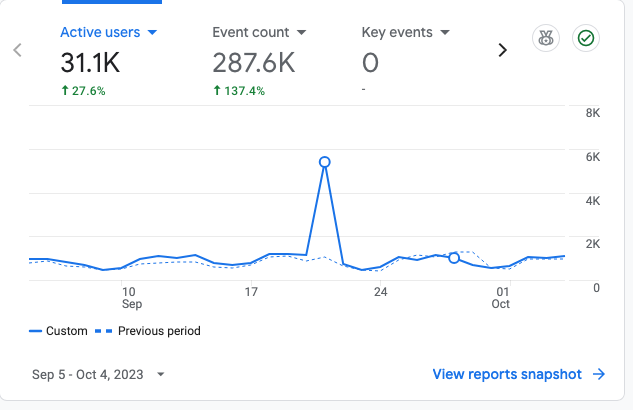
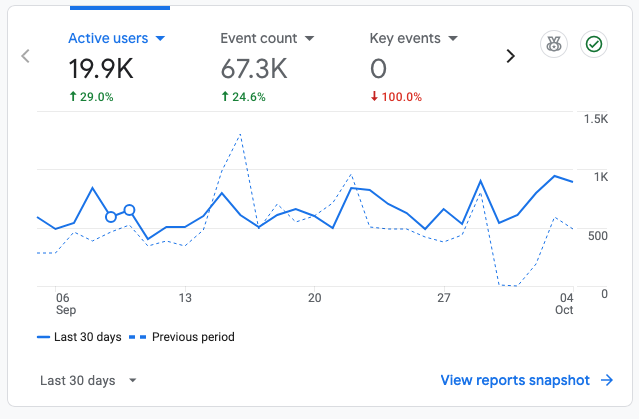
In the same 30-day window of 2023, this site had 31.1K active users, about 1,000 a day. This year the same window shows 19.9K. Like nearly every site that lives on search, we lost a large share of our clicks, and the cause was easy to identify: the traffic was leaving through AI answers. Over the last three months we reversed the trend. We have not recovered the traffic. This post covers what we did, what the numbers show with their caveats, and the two mistakes we made along the way.
Where did the clicks go?
Publishers have described the same pattern for two years: an AI answer gives people the information on the results page, so fewer of them visit the source. A Pew Research Center study of 900 US adults, using data from March 2025, found that people clicked a traditional result in 8% of visits when Google showed an AI summary, against 15% when it did not.
The sharpest evidence comes from a lawsuit. The New York Times sued Microsoft and OpenAI in December 2023, in a case you can read about on Wikipedia. Filings unsealed in September 2026 include a January 2024 internal memo in which a Microsoft director of applied science, Brent Hecht, called AI scraping “an astonishing theft of unprecedented proportions” and possibly “the largest theft of labor in human history”. Nick Turley, who leads ChatGPT, described in internal communications an “existential threat” to publishers from products that are “largely substitutive”. And Microsoft’s own data, as cited in the filings, reportedly showed click-through rates from Copilot to the Times up to 93% lower than from traditional Bing search.
These are statements from court filings and internal documents, not findings by a judge. Microsoft has said Hecht’s comments are one employee’s individual perspective and do not represent the company’s views. Both companies argue their use of news content is fair use, and a ruling is expected in 2027.
I am not taking a side on copyright law. The point for anyone running a site is that the loss of clicks is not a temporary dip, so waiting for the clicks to come back is not a plan.
First step to grow a website: Stop the decline
When the loss started to look serious, we designed a recovery plan. It began with classic SEO work, the kind we do at Flamine, but the real question was how to optimize for AI search, because that was the channel where we were losing traffic.
The answer was a multichannel strategy that used every available channel at once: SEO, GEO (generative engine optimization), social media, user-generated content, PR and high-quality backlinks. My reading is that both search engines and AI assistants weigh what the rest of the web says about a site, so a page that is only optimized on its own domain is easy to overlook.
At the same time we ran experiments on the site itself: content changes, Schema markup, and updates to pages with outdated information. We also rebuilt the design and the code from scratch, always aiming for speed and a better user experience. And we filtered our traffic more carefully, so that a bot attack could not pass as growth.
What the numbers show
In a little over three months the trend reversed. The comparison below needs caveats, so I will give them next to the figures.
Two caveats. The 29% compares against a window that includes a dip around the end of August, when daily users fell close to zero for a short stretch, so I read the real growth as closer to 15%. And the 2023 window includes a one-day spike, so without it the gap with today is about a quarter, not a third. Both readings say the same thing: the decline stopped, and we are not back to where we were.
The most encouraging number: traffic from AI assistants

The result I care about most is not in the total. Sessions from AI assistants average about 150 a week and the trend is rising. In a recent weekly report, ChatGPT sent the most, followed by Gemini, Claude and Perplexity. They are about 2% of our sessions, but they behave differently: roughly 85% of those sessions were engaged, against about 61% for the site as a whole. The sample is small, so I treat it as a signal and not a conclusion.
| Metric | Value | Change | What it means |
|---|---|---|---|
| ChatGPT | 69 sessions | 44.5% | 66 engaged sessions, about 96%. |
| Gemini (gemini.google.com) | 43 sessions | 27.7% | 32 engaged sessions, about 74%. |
| Claude | 21 sessions | 13.6% | All 21 sessions engaged. |
| Gemini (no domain) | 11 sessions | 7.1% | 4 engaged sessions, about 36%. |
| Perplexity | 11 sessions | 7.1% | 8 engaged sessions, about 73%. |
Two limits apply. Some AI visits arrive without a referrer, so these numbers undercount. And my expectation that more is coming is a guess: we assume new content takes about a year to reach model training data, so we may not have seen the full effect yet. Live retrieval by assistants is faster, so part of the gain may come sooner.
Two spikes that were not growth
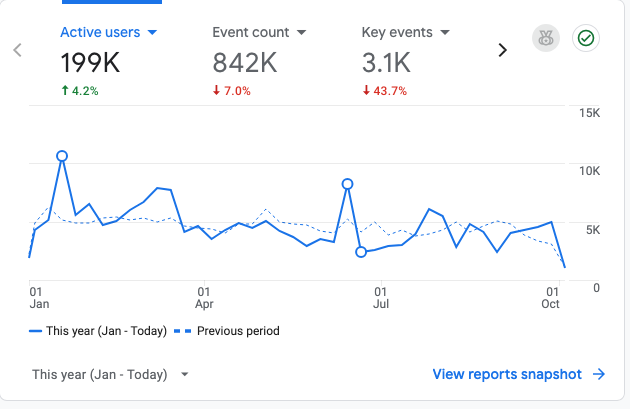
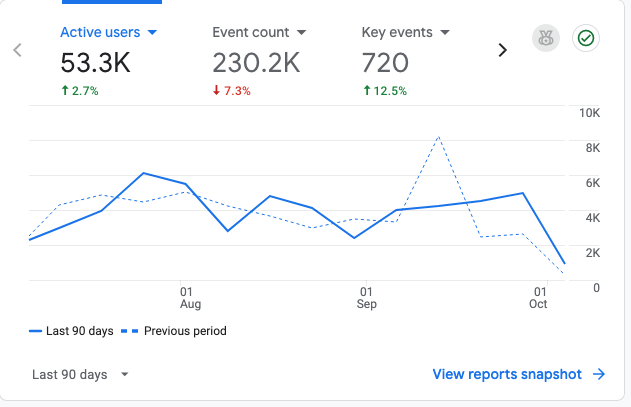
Our year-to-date chart has two sharp peaks. The first, in January, came from a mention on the front page of Inc, and it lasted only a few hours. The second, in late June, was a bot attack. On a weekly chart both look like wins, and neither was. That is why we now filter bot traffic before reading any growth number, and why I look at the weekly baseline instead of the peaks. Since early September it has climbed from roughly 4,200 to roughly 5,200 users a week.
Two mistakes we made
The bigger one was technical. Over a weekend, with a deadline running on a large client project, we made an error on the site and did not check it carefully, because this site is where we run experiments and build links and mentions for clients, and other work had priority. Google dropped nearly all our posts from the index and kept only the pages. The site is a custom WordPress build, and it happened in the middle of Google’s September spam update, which began on September 24 and has not finished rolling out. Within 72 hours every post was indexed again, with a slight loss of positions that we are not worried about while the update is still running. Because we track AI traffic weekly, it showed no drop. If there was one, it had already recovered.
The second was smaller. When we launched the new design, the contact form lost the tracking the old one had, so Analytics reports zero key events for the last 30 days on a site with almost 20,000 active users. The zero in our 2023 report is a different case: key events were never configured back then.
Both come from the same habit, treating our own site as low stakes. The fix is a short routine. Before a launch, list every event and key event the old site fired, test each one on staging and confirm it in GA4 DebugView. After launch, check that your templates are still indexable and watch the page indexing report in Search Console. Set an alert for any key event that drops to zero.
What I would take from this
We could not stop the flow of traffic leaving the site, so stopping the decline mattered, and reversing it mattered more. What helped, in my view: working every channel at once, rebuilding the site for speed and experience, measuring AI traffic weekly because the daily numbers are too small to read, and testing every deployment, including on the site you consider a sandbox.
Frequently asked questions
No. The case is pending in the US District Court for the Southern District of New York. Both companies argue their use of news content is fair use, and a ruling is expected in 2027.
In a January 2024 internal memo, Brent Hecht called it “an astonishing theft of unprecedented proportions” and possibly “the largest theft of labor in human history”. Microsoft has said his comments are one employee’s individual perspective and do not represent the company’s views.
In the traffic acquisition report, set the dimension to Session source / medium and search for AI assistant sources such as chatgpt.com, gemini.google.com, claude.ai and perplexity.ai. Some visits arrive without a referrer, so the real number is higher.
Because they put the information on the results page, so many people no longer need to visit the source. A Pew Research Center study found clicks on traditional results in 8% of visits with an AI summary against 15% without one.
Compare the weekly baseline over several weeks instead of the peak, find the source of the spike, and rule out bot traffic. A spike that fades within days, like a press mention or an attack, is not growth.
At Dorve we have been designing experiences for nearly three decades, long before AI was part of the conversation. If you want a second pair of eyes on your measurement or your indexing before a launch, see what we do or tell us what you are building.